
- Gamlingay (main menu)
- Service and Utilities
- Leading page
- Village Diary
- News from St Mary's
- Church Services -
Gamlingay, Everton and Hatley St George - News from the Baptists
- Community Corner
- Church Mouse
- Parish Council News
- Vandalism and Graffiti
- Gamlingay Art Exhibition and Heritage Weekend
- Outside Edge - Gamlingay Players
- Neighbourhood Watch
- Host
- Gamlingay Village College
- Heart for You
- Poetry Hawk
- Poetry Robin
- Poetry The Gunpowder Plot
- Yew Clippings are valuable!
- Stepping Stones
- Green Wellie
- What’s On?
In the November
2000 Issue
Green Wellie |
A
s I know nothing of vine weevils and have not had experience of them (yet) I thought a bit of
research might prove a timely precaution. Other people found them a real pest and I wondered why I haven't had them so far.
I owe my information to The Garden (April issue). This is the magazine of The Royal Horticultural Society.
Adult vine weevils are found from spring to autumn but remain inactive during the winter months and until the soil warms up. All the insects that you see are female and lay up to 1,000 clonally produced eggs which are less than 1 mm in size. All the eggs are not laid at one time or indeed on one site. As a general rule if you see eggs they are not vine weevil. The larvae can, however, easily be seen. They are 10 mm in length, white with a brown head. The time of incubation on plants or in the soil will vary according to the temperature and may take from 8 1/2 days to 56 days.
The larva eats the roots of plants, particularly young juicy stems, such as Impatiens ( Busy Lizzie ) or Begonias. If you suspect you have a vine weevil it is a good idea to remove the plant from its pot and wash off all the soil. You'll probably find grubs consuming the roots.
The way many people garden nowadays has caused the incidence of vine weevil. The vine weevil is a native to this country and before 1989 could be dealt with by Aldrin which was an effective control. Aldrin is however highly toxic and was withdrawn in 1989. This was just the time when more and more attractive patio pots were being sold and more people with small gardens tended to have a few pots around a sitting out area. The normal predators such as birds, frogs, shrews and hedgehogs are far more effective in flower borders than when dealing with pots.
Nurseries now sell almost entirely container grown plants which are an ideal habitat for vine weevils. The weevils are carried from the garden centres around the country and thus into our gardens.
There is a predatory nematode which parasitises vine weevil but they do need temperatures between 14 degrees and 20 degrees centigrade. The nematode unfortunately dies in the winter. The best time to introduce them into your garden is during August and September as they will invade the vine weevil grubs before they grow large enough to do damage.
There is also a recently introduced insecticide called Imidacloprid. This comes in two forms one, as a drench, called Bio Provado Vine Weevil Killer. The other comes as a compost with slow release granules of the pesticide. In the compost form the product is called Levington's Plant Protection Compost and comes in three forms, for outdoor containers, ericaceous containers and house plants. This compost is best used when potting up young plants. The plants absorb the chemical and this kills the grubs when they attack them. The insecticide also acts against sap sucking insects such as blackfly, whitefly, greenfly, and scariad fly. The compost can be obtained nation-wide in good garden centres. These products are only licensed for use on ornamental plants grown in containers and should not be used elsewhere.
Unfortunately vigilance is required against this pest and hygiene in seed tray washing and pot washing is essential. You must try to attack them before they get a hold.
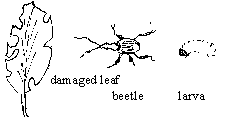 You will know if you have vine weevil if the leaf margins of the plants have been unevenly eaten or if the plant wilts. The leaf margins are eaten at night by the slow moving adults who cannot fly but can climb.