UK News links
In the May
|
T
he villages seem to have been affected by two different pestilences over the last few weeks.
First, there has been the continuing pestilence of the motor car aggravated by the closure of Mill Road
whilst road works have been undertaken. Of course the work needed to be done and the road condition is
much improved but the effect of the closure of the road on the village as a whole has been amazing. Church
Street is busy at the best of times but for long periods of time it seemed to grind to a total halt whilst vehicles
weaved in and out of parked cars. One of the other effects of the roadworks has been the proliferation of the
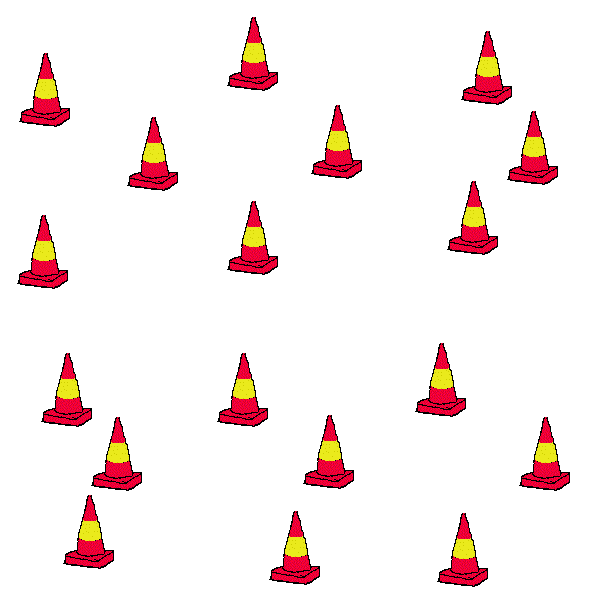
new mini traffic cones along Stocks Lane and Honey Hill in particular. I warned last year that I thought that
the two large cones which had been left on Honey Hill for months would probably reproduce and they have
done so. Their progeny is everywhere, including regularly being found in my front garden.
The other pestilence has been much more serious and much more worrying. At the time of writing the Foot
and Mouth disease has not reached Cambridgeshire, and I really hope that it will not do so, but the effects of
the epidemic can be seen all around us. Footpaths are closed and many farms have straw soaked in
disinfectant strewn across their drives.
Many of the media have been telling us that the countryside is closed. For us who live in a rural community
that is clearly nonsense. But even though many of us are unlikely to be directly affected by the consequences
of this disease in any way, we can still see much more clearly than those living in town and cities what the
dreadful implications of this disease may be.
Day by day the disease appears to be spreading inexorably and may be getting closer to us here. Maybe
now we can start to realise what it must have been like to live in Gamlingay hundreds of years ago when
there was a constant threat of diseases fatal to humans, such as the Plague, spreading across the countryside.
The people then, like the farmers now, never knew when the disease would arrive and they took many steps
to ensure that it did not affect them. No wonder villages then tended to be much more self-reliant and able to
cut themselves off from the rest of the country. Our jobs and schools and retail arrangements mean that we
cannot do this for any length of time now. But, although rural communities cannot be completely cut off, I
am increasingly aware of a widening chasm between rural and urban communities. There really is a
surprising amount of ignorance in towns and cities about life in the country. We know that life here is not
simply focused on house parties and fox hunting. Maybe recent media coverage of the appalling effects of
Foot and Mouth will open the eyes of ‘townies’ to the hardships that many have to suffer in rural
communities. But, of course, on one level, there is no difference between town and country at all; traffic in
villages such as ours is just as bad as any large town or city.
|